Sunday, January 9, 2022

Zombie Blog Update

 Greetings, dear reader.  It's been some time since I've been updating things here, as I've been more focused on the oud and Arabic music for the past several years.  

I'm discontinued this blog, but am continuing on my website in modified form, consolidating my various interests in one place.  I'll still be occasionally posting about jazz, improvisation and guitar, but also about oud and Arabic music as well as composition and music more generally.  

I've also migrated all the old posts and updated the versions on my website to fix broken links etc. where possible and will be keeping that version up to date. 

If you're interested in reading more, here it is:https://brianprunka.com/words

Sunday, February 8, 2015

Key-oriented perspective

It's very common in jazz education to encourage a chord-oriented perspective on improvisation. In many ways, this makes a lot of sense and can be a valuable way of analyzing the music. However, it runs the risk of one failing to see the forest for the trees when applied to many tonal jazz standards, where a key-oriented approach provides a better perspective of how everything really fits together.  It can also lead to more lyrical, melodic lines that can provide a contrast to lines that outline the chord changes more.   Ultimately, I think both perspectives have their place.  Obviously, in tunes that are less tonal, the key-center perspective becomes much less useful.

 I was thinking about this today and thought it would be interesting to look at the diatonic chords in a key, and compare what notes in the key worked where, to get a global view of the relationships. The results are interesting, I think:
Green: works
Orange: mildly dissonant
Red: strong dissonance
What is interesting here is how nearly every note in the key "works" against nearly every chord.  In particular, that scale degrees 2, 3, 5, and 6 can be used anywhere.  Note that this is 4/5 of the major pentatonic scale.  The 7th degree works nearly everywhere (and even the dissonance against the ii chord is fairly mild).  If you take 5, 6, 7, 2, 3, then you have the major pentatonic on the 5th degree as being a pretty much failsafe option against any diatonic chord.    

Also interesting: 

• Nothing conflicts with the IV chord (this is just the scale-oriented version of the observation from the standard chord-oriented perspective that the Lydian mode has no "avoid" note).  

• The 1st and 4th degrees are the only ones that are seriously problematic.  The first degree clashes with the dominant functioning chords (V and vii°) and the 4th degree clashes with the tonic-functioning chords (I and iii, and to a lesser extent, vi).

While I do not advocate mindlessly improvising according to general rules, I do think it is interesting and perhaps helpful to be aware of the relationships in the big picture.  And of course "works" and "doesn't work" is a extremely simplistic framework for understanding relationships, one could conceivably do a much more nuanced chart of how every scale degree and chord relate to one another (and I think that every accomplished improviser does have a personal sense of this, whether or not it is conscious or articulated).

For instance, a very slightly more nuanced chart might be:
Same as above, but add:
Yellow: subtle tension

The fourth degree on a minor chord has a slight tension to it in normal tonal progressions, so one could further refine the chart with this information.  This is moving us a bit in the direction of a chord-oriented approach.  However personally useful this is, it does make the big picture less clear, which is what I meant earlier about missing the forest for the trees.

Then I thought, what about common chromatic chords? So I made the following chart:


Obviously quite a bit more red here, as one might expect in restricting melody choices to diatonic scale degrees while adding in chromatic chords: at least one note in each chord is outside the key.  

Here are my observations:
• The tonic works against all of these common chromatic chords.  
• II7, III7 and VI7 only have one conflict, the 4th of each chord (2, 5, and 6, respectively).  This results in an interesting tetrachord that will work over all three: 1 3 4 7 (the two diatonic half-step pairs).  Although a chord-oriented approach also advises against the 4th degree on a dominant chord, it is interesting to analyze these three dominants according to a chord-oriented approach to observe the differences: II7 (7, 1, 9, +9, 4, 5, 13), III7 (b13/+5, 7, 1, b9, +9, 4, 5), VI7 (+9, 4, 5, b13/+5, 7, 1, 9)—using notes from the key actually encourages the use of altered 9ths and 13ths with respect to the chordal harmony.
• bVII7, a common chord in bebop, works great with the first 5 degrees of the scale (and results in 3,  5,  9, #11, 13 against the chord).
• #iv diminished 7, a troubling chord for a lot of students, works great with the simple 1 2 4 6 7 (rearranged as 6 1 4 7 2 it becomes 3, b5, 7, 11, b13 relative to the chord) 


One of the things that comes from adopting the perspective is that you start to see the key as stable, and the chords as merely temporary events that are happening in the context of the key.  While it's important to be able to zero in on the notes that change (i.e., playing the "changes") it's also effective to emphasize the stable notes that aren't changing.  The simple fact that the 5th degree works over every diatonic chord, for example, could be used as a unifying central element in an improvisation using many other elements.  

I frequently make the observation that any note in a piece of music is simultaneously functioning with respect to the key and with respect to the current chord.  That means that a chord can be stable/tense on two different levels at any given time, and they can agree or conflict (there are 4 different possibilities, obviously with many subtle gradations: key stable/chord stable, key stable/chord tense, key tense/chord stable, key tense/chord tense).  It can be valuable to consider both ways that any note is working.  Here is a chart with a few examples of how things can line up.  In this case, I think it is helpful to consider more subtle shadings of tension, so here I only included unambiguous cases:


Note that any note that is chromatic to the key would be fairly tense—this is an issue often that confuses students when they are told things like "natural 9 is consonant on a diminished chord", which is true (chord-stable), but in many key contexts, the natural 9 of the dim. chord is extremely key-tense.  For example, the common #iv°7 would have #5 of the key, a very tense note, as the 9.  It's not unusable, but it requires extra care to use it musically.  Each particular combination of notes/chords is different, but you can see that there would be at least 3 basic categories of tension: stable (key-stable/chord-stable), mixed tension (key-stable/chord-tense, key-tense/chord-stable) and very tense (key-tense, chord-tense).    

For a practical exercise that has some relationship to all this analysis, see the following post:

This isn't really a methodical theory approach as much as it is just some thoughts and observations that I thought might be helpful. I'll be curious to hear any thoughts you might have in response to these ideas.  

Tuesday, March 27, 2012

"Bill Evans"-derived Rootless voicings for guitar, part 2

Here are more rootless voicings for guitar, based on the "Bill Evans" left-hand style voicings.

These are mostly drop-2 chords, so unlike Evans's close voicings, these are open voicings. This does change the character of the sonority considerably; if the aspect of Evans's voicings that you want to imitate is the crunch of the 2nd, then the close voicings in the previous post or 3-note voicings would be more appropriate.  That consideration aside, these are very useful and hip-sounding voicings.

Perhaps I'll deal with a 3-note voicing approach in some future post.

Again, I've arranged these in the context of a II V I progression to clarify the voice leading and usage.
See my notes from the previous post for more details.

These are all on the 1234 string set, but most of these can be translated to the 2345 string set.  You can do this yourself (it's a great way to learn), or wait a few days and I'll post the 2345 voicings.

Bill Evans Rootless Guitar voicings, 1234 string set, page1

Bill Evans Rootless Guitar voicings, 1234 string set, page 2

Bill Evans Rootless Guitar voicings, 1234 string set, page 3


     At this point, you may be wondering about the directive that the voicings must have either the 3rd or 7th (or 6th) on the bottom.

 The main reason for this is that without the root motion, the 3rds and 7ths provide the clearest definition of the chord sound; having them on the bottom just makes it sound stronger.  However, the reality is that you may sometimes prefer to voice another note on the bottom; the alternatives obviously are 1 (or 9) and 5 (or 6).

Interestingly, if you alternate all 3rds and 7ths, or all roots and 5ths, you end up with smooth descending voice leading through circle of 5ths progressions.
If instead, you mix them, you can create interesting contours, some ascending and others descending.
For instance, 3579 to 1367 to 5793 to 3579 creates a general upward movement instead of downward.

Also, when comping, the general downward trend of tonal voice-leading means you eventually either run out of fretboard (or keyboard), or you have to break the voice-leading by leaping upward occasionally.  There are a few ways to smooth this out.

One is to make the leaps after cadences, where they are less disruptive (e.g., ii7 V7 I VI7, you leap to the VI7, not to the V7 or I, so that the cadence has smooth voice-leading).

The other is to make judicious use of inversions that lead upward once in a while—for this, the voicings with the 1, 9 or 5 on the bottom are most useful.

I suggest mastering a substantial portion of the voicings with the 3rd and 7th on the bottom before messing with the others.

Sunday, March 25, 2012

Added-Note Triad Applications

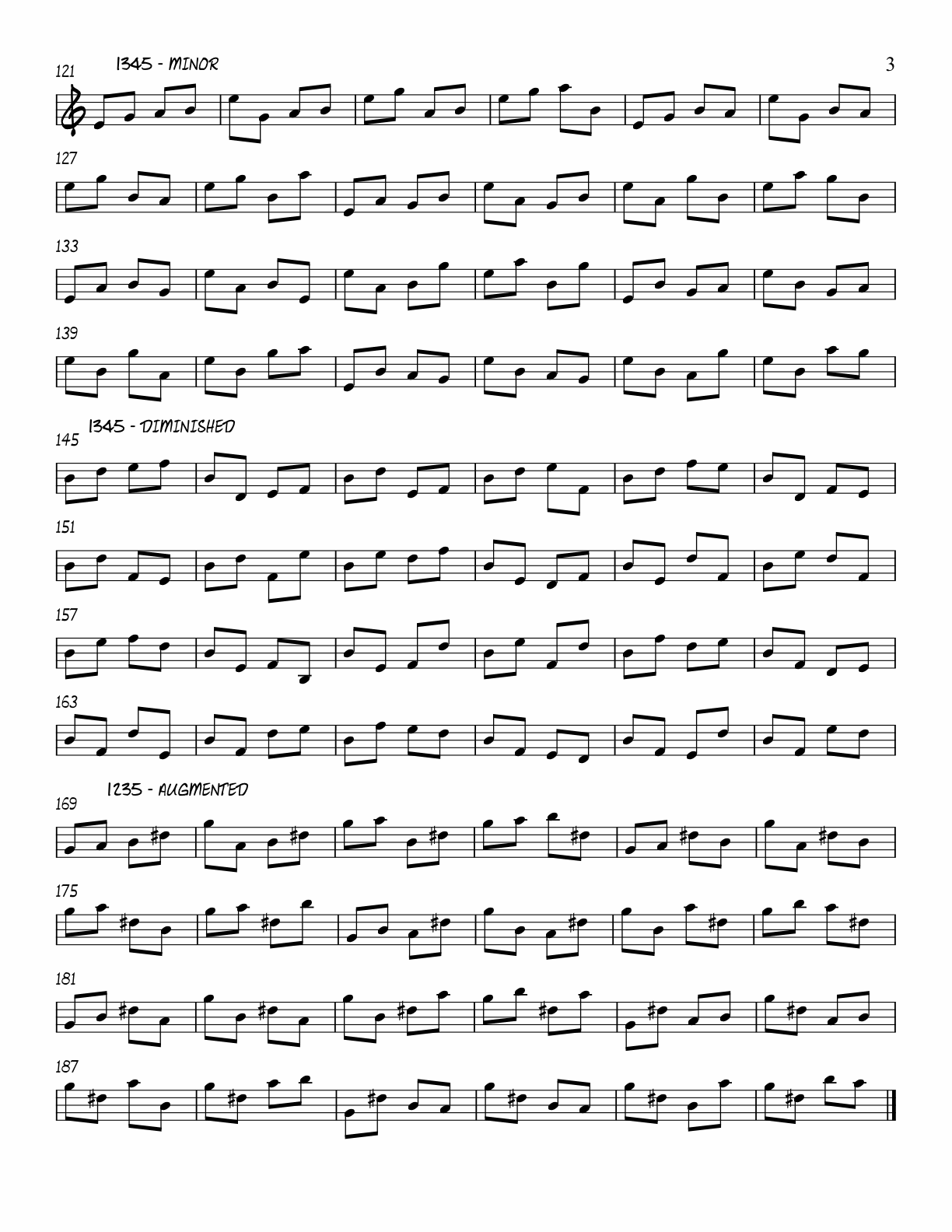
The uses of triads for an improviser are nearly limitless. As I hinted at in my previous post on digital patterns, adding a note to a triad to create a four-note group can create a lot of possibilities.  The standard digital patterns 1235, 1345, and 1356 are all examples of a triad with an added note (1356 and 1357 can also be considered arpeggios). 

I'm working on putting a whole book together of various ways of incorporating triads into your playing.  Here's an excerpt from the section on added-note triads.  I indicate the scales in which the pattern can be found, as well as the main harmonies over which it can be used.  Of course, these can be used with substitutions as well, and with more 'outside' playing to break out of the strict harmony.

I indicate the pattern with either a capital or small "m" for major or minor triad, "A" for augmented, "d" for diminished, with the interval from the root of the triad (using +/- to indicate a sharpened or flattened degree.  For example, M-2 = Major, with added b2.


There are a lot of ways to practice incorporating these ideas.  The first thing I would suggest is getting familiar with all the inversions and permutations.  Then pick a simple chord progression like "Autumn Leaves" and figure out all the places where various transpositions can be used.

For example: M4
Cm7: BbM4, FM4, EbM4
F7: FM4, DbM4, GM4, AbM4, BM4(Tritone sub)
Bbmaj7: FM4, BbM4, CM4, AM4, DM4
Ebmaj7: BbM4, FM4, EbM4, DM4, GM4
Aø7: FM4, GM4, EbM4(Tritone sub)
D7: DM4, BbM4, FM4, AbM4 (Tritone sub), EM4, BM4
Gm6: DM4, CM4, FM4

Have fun! 

"Bill Evans"-Style Rootless close voicings for guitar — II V I

Here is a set of rootless voicings for guitar that I adapted from the stock "Bill Evans" style left-hand voicings.  I show them in a II V I context to illustrate the voice leading, but they can of course be adapted to fit any chord progression.

Close voicings tend to be difficult on the guitar, as they contain smaller intervals.  Many of these involve challenging, but not impractical stretches: they should be usable by most guitarists, unless you have rather small hands.  When practicing these, make sure you are warmed up first, well-hydrated, and take frequent breaks, as it is easy to overdo it when practicing these kinds of stretches and you want to avoid injury.

For those unfamiliar with the principles of the "Bill Evans" style voicings, here are the main principles:

    • They are generally voiced with either the 3rd or 7th on the bottom
    • The basic structures are 3715 or 7135—note that the chord can contain the root, they are just "rootless" in the sense that the root is not in the bass
    • On m7 chords, the root may be replaced with the 9th, and the 5th may be replaced with the 11th
    • On 7 chords, the root may be replaced with the 9th, and the 5th may be replaced with the 13th or #11 if appropriate
    • On Maj7 chords, the root may be replaced with the 9th, the 5th or 7th may be replaced with the 6th
    • One m(maj7) chords, the root may be replaced by the 9th, the 5th or 7th may be replaced with the 6th
    • In circle of 5ths motion, alternating voicings with 3 and 7 on the bottom will create smooth voice leading.

Here are the resulting possible combinations (not voicings, just note choices):

m7 (1 3 5 7), m9 (9 3 5 7), m11 (1 3 4 7), m11 (9 3 4 7)
7 (1 3 5 7), 9 (9 3 5 7), 13 (1 3 6 7), 13 (9 3 6 7),  #11 (1 3 #4 7), #11 (9 3 #4 7)
Maj7 (1 3 5 7), Maj9 (9 3 5 7), Maj13 (1 3 6 7), Maj 13 (9 3 6 7)
6 (1 3 5 6), 6/9 (9 3 5 6)
m6 (1 3 5 6), m6/9 (9 3 5 6)
m(maj7) (1 3 5 7), m9(maj7) (9 3 5 7), m13(maj7) (1 3 6 7), m13(maj7) (9 3 6 7)

Of course, the 9ths on the 7 chords can be altered as well, and #11s can replace 5ths in the maj7 chords also when appropriate. I also bent the "rules" in a couple of cases because of guitar limitations.


On the following pages, the chords are presented in columns.  Any chord in the II column can lead to any chord in the V column, which can in turn lead to any chord in the I column.

This isn't to say that all combinations work equally well or in all cases. 
For example, using a m13(maj7) chord when the chord in the tune is Maj7 will probably not work so great (but don't let me stop you!).

Here are the voicings where the II chord has the 3rd on the bottom.  Because of the 2nd between 7-1 and 9-3 that occurs on the II and I chord when you start with the 7th on the bottom, there are not many practical voicings on guitar that way.  There are some, however, and I'll post them soon along with the drop-2 versions of the chords and some tips on how to get creative with them while comping.


Wednesday, March 21, 2012

Digital Patterns

Okay, I haven't posted in a year. Here's a little worksheet of common patterns that are often used by modern improvisers. John Coltrane was probably the first to make notable use of these kinds of patterns, which he did on the record "Giant Steps".

I took the basic patterns and explored the possibilities for reordering the notes and for octave displacement.

There are 24 different ways to order four notes, these are all listed for each type.
If you add in octave displacement of various notes, you end up a lot more variations. I just did the first example from each chord type . . . you can work out the rest.


You can use these starting on different chord degrees, the first page lists some possibilities:
  •  Use the major pattern from the root or 5th of a maj7 chord, or from the 3rd or 7th of a min7 chord
  •  Use the minor pattern from the 3rd or 6th of a maj7 chord, or from the root or 5th of a min7 chord

There are other possibilities for half-diminished, diminished, or dominant chords:
Dominant: Major from root or 6th, dim. from 3rd, minor from 5th
Diminished: Dim. from root, b3, b5, or 6 (bb7)
Half-diminished (min7b5): Dim. from root, minor from b3 or 4, aug. from b5, major from 7.

By altering these, you can get a bunch of patterns that are useful over dominant and diminished.
You can also substitute and extend these, for example:
 •  Playing the patterns for Db7 will give you altered sounds when applied to G7
 •  Playing the patterns for Em7 will give you Lydian sounds when applied to Cmaj7
 •  The patterns for min7b5 work for a min6 chord a m3rd up (use Amin7b5 for Cmin6)

Which brings up another idea, these patterns are all a triad with one added note, a useful concept.  Could be another post to come . . .

PDF here

Friday, December 17, 2010

Ear Conditioning

Here's an (IMHO) excellent exercise that trains your ears and works on connecting your hearing and improvising. I forget where I got the initial idea, but this the the procedure I've developed and found helpful:


Take a chord progression (maybe a blues to start, or just I-vi-ii-V, or an easy standard like Autumn Leaves). Play through the whole chord progression on a chordal instrument, very slowly, while singing the tonic of the key over every chord (even the ones where it doesn't 'fit', even if the apparent key changes).

Repeat, singing the 3rd of the key.
Repeat, singing just 1 and 3.
Repeat, singing the 5th of the key. Then combine 1, 3 and 5. Depending on your range, you may add in octaves of these notes as well.

You may be surprised at this point how much music can be made with just those three notes, and that most chord changes can be negotiated by simply switching to one of the other two notes.

Keep repeating the tune (over several practice sessions), adding in the remaining diatonic tones. I recommend the following order: 6th, 2nd, 7th, and 4th, but feel free to experiment.

When you add a new interval follow the following pattern:
1st chorus: only the new interval {x}
2nd chorus: only 1 + {x}
3rd chorus: only 1, 3, 5 + {x}
4th chorus: all intervals

Once you can do this, again it may seem surprising how much you can play and negotiate changes just using the diatonic notes, by hearing which notes work where and how.

Then you can start adding in chromatic tones. I like to start with the "blues notes": b3, #4, b7. Then eventually add #5 and finally b2 (crunchy!).

In all of the above, I'm talking about the interval in the key, not intervals in relation to each chord.

Once you've done all 12 notes, then you can try going through the progression singing the root of each chord, then the 3rd, 5th, etc.

Note that different keys will put different intervals in different parts of your range. Practicing in different keys is helpful so that sometimes the tonic is in the middle of your range, sometimes at the low end, etc.

Wednesday, August 25, 2010

Maj7#5

Update: I linked some parts to my previous posts on Augmented Scale ideas.

Over at the All About Jazz forum, someone asked for suggestions about how to approach Maj7#5 chords. As this is a sound I'm fond of and have spent considerable time exploring, I posted a rather lengthy response.
I'm reprinting part of my response here, since I think it may be of general interest. It's somewhat off the cuff, so the information is probably not optimally organized, so apologies in advance.

--

Maj7#5 can take some different sounds, depending on context. Lydian Augmented (third mode of melodic minor) is one of the scales most commonly recommended as being compatible with a Maj7#5 chord. It's not the only one, though, and others might work much better, depending on the context.

Here are some other possibilities:

Harmonic Minor, 3rd mode (A harm.minor = CMaj7#5)

Harmonic Major (C harm. major = CMaj7#5)

Harmonic Major, 6th mode (E harm. major = Cmaj7#5)

Lydian #5 #2 (C D# E F# G# A B --this is Melodic Minor #4, 3rd mode, i.e., A Melodic Minor #4 for Cmaj7#5)

Symmetrical Augmented scale (C D# E G Ab B)

Harmonic Major (6th mode) is the same as Melodic Minor #4 (3rd mode) AKA Lydian #2 #5. Just two ways of thinking about it.

What notes will work best over the chord will depend greatly on the harmonic context, e.g. the preceding and following chords, etc.

Try finding some tunes that have the sound in it, substituting it in standards, or writing your own, to experiment with different contexts.

The symmetrical augmented scale is a great sound and can be considered as two augmented triads a 1/2 step apart (contrast with the whole tone scale: two augmented triads a whole step apart). Since augmented chords are symmetrical, any note can be considered the root.

Cmaj7#5: C+/B+ or E+/D#+, or Ab+/G+

You can also extend each triad into a maj7 arpeggio:
Cmaj7, Emaj7, Abmaj7

see: More Augmented Scale

or maj7#9:
Cmaj7#9, Emaj7#9, Abmaj7#9

Or you could construct arpeggios by combining the triad pairs into polychords:

B+|C+
=
C E G# B D# G

Eb+|E+
=
E G# C Eb G B

G+|Ab+
=
Ab C E G B D#


You can also reconsider the scale as a major and minor triad a m6 apart:

C/Abm or E/Cm or Ab/Em

There are a million ways to practice these.

Triads in the Augmented Scale

One observation:

Of all the different scale choices over Maj7#5, two particular areas tend to stand out for me:

The choice of whether to incorporate a P4 vs. an A4
The choice of whether or the M6 is included (the alternative is generally the P5)

Since these involve half-steps above the determining color tones of the chord, care must be taken with the melodic resolution tendencies.

The choice of A2 vs. M2 (i.e., #9 vs. 9) is a useful color, but rarely obscures the harmony.

1. Lydian Augmented: has #4 and M6. The #4 implies a Lydian sound and can be a sustained tension, but the dissonance of the M6 obscures the harmony and must be used carefully

2. Harmonic Minor, 3rd mode (Ionian #5): Has P4 and M6, both of which can obscure the harmony and require careful use.

3. Harmonic Major (Ionian b6): Has P4, but no M6.

4. Harmonic Major, 6th mode (Lydian Augmented #2): Has #4 and M6, like Lydian Augmented.

5. Symmetrical Augmented: has neither P4, A4, or M6.

Since #5 omits the problematic tones, it may be an easier scale to start with: it is less likely to lead to obvious clams.

One could create another 6-note scale that leaves out both P4, A4 and M6:
C D E G Ab B. Such a scale might be useful. It could be viewed as a C+/G triad pair or (perhaps less usefully) as a C/Abdim triad pair.

There are a couple of hexatonic subsets that leave out P4 and M6, but include the A4:
C D E F# G# B: this is C+/Bm, a subset of Lydian Augmented
C D# E F# G# B: This is C+/B, a subset of Lydian Augmented #2

The following pentatonics can work as well:
E F# G# B D (these notes form an E9 chord)
Ab B C E F# (these notes form an Ab7+5+9 chord)
C D E F# G# (this is a subset of the whole tone scale, omitting the b7, or the Lydian Augmented, omitting the 6 and 7)
E F# G# B C# (E6 chord or E Maj pentatonic)

The last one includes a b9 on the chord, but this can be a great sound on a modern tune, especially if the chord lasts for a measure or more. It usually works better in the upper register, where it sounds like an extension.
__________________


So there end up being four primary 7-note scale and one 6-note scale possibilities, and a number of pentatonic and hexatonic choices. Here again are the five primary types:

1. Lydian Augmented (AKA Melodic Minor, 3rd mode):
R M2 M3 A4 A5 M6 M7

2. Harmonic Minor, 3rd mode (AKA Major #5):
R M2 M3 P4 A5 M6 M7

3. Harmonic Major:
R M2 M3 P4 P5 m6 M7

4. Harmonic Major, 6th mode (AKA Melodic Minor #4, 3rd mode AKA Lydian Augmented #2):
R A2 M3 A4 A5 M6 M7

5. Symmetrical Augmented:
R A2 M3 P5 m6 M7

Not all choices work equally well in all situations.
No warranty is expressed or implied; indiscriminate scale usage may result in clams, tomatoes, or acts of violence. I do not take responsibility for the careless use of the above information.

happy improvising!

Thursday, March 11, 2010

Guitar Players: Learn all the notes--update

As a follow up to the previous post about how to learn the notes on the guitar neck, I made a graphic to visually represent the "white notes" on the guitar.  This is what you should 'see' when you look at or think of the guitar fretboard.

Friday, February 26, 2010

Ear Training

Ear training is obviously an extremely important pursuit for improvising musicians.  I spend a significant portion of my practice time on ear training activities, and try to find ways to incorporate an ear training aspect into all of my practicing.

One of the things that makes harmony so complex is that as you add notes, the complexity increasing in a combinatorial way, not an additive way.  For example:

If you hear an E against a C, it's one piece of information: major 3rd.

If you hear an E and a G against a C it's 3 pieces of information: major 3rd between C and E, perfect 5th between C and G, and minor 3rd between E and G.

If you hear an E, G, and B, against a C, it's 6 pieces of information: major 3rd between C and E, perfect 5th between C and G, and minor 3rd between E and G, major 7th between C and B, perfect 5th between E and B, major 3rd between G and B.

If you hear EGBD against C, it's 10 pieces of information: major 3rd between C and E, perfect 5th between C and G, and minor 3rd between E and G, major 7th between C and B, perfect 5th between E and B, major 3rd between G and B, major 9th between C and D, minor 7th between E and D, perfect 5th between G and D, minor 3rd between B and D.

Et Cetera.

So in order to learn all the sounds, we need to give names to specific combinations, like triads, and ultimately triads with added notes (including 7ths).

I've made a set of audio files (mp3 format) based on an exercise suggested by Rufus Reid.  Each file presents one of the four triads (Major, Minor, Augmented, or Diminished), and alternates with adding one of the twelve available tones to it.  The idea is to learn to hear the sound of all the available notes over each type of chord.

Download file here.

I used triads because once you can identify the sound of the 6ths and 7ths over a triad, then hearing more complex chords is merely a matter of identifying the chord as (Maj, Min, Aug, or Dim) triad+(6, b7, or 7) + additional note(s).

There are more than 12 files for each chord, because I included some notes in more than one octave (specifically, the 2nds/9th, 3rds/10ths, 4ths/11ths, and 7ths).  I did this because these notes can have some additional different characteristics when voiced close to the chord, and these differences can distract you from hearing the essential characteristics.  For these notes, I suggest spending some time going back and forth between the lower and higher version in order to focus on part of the sound that doesn't depend on what octave you're in.

There's a lot here (76 33-second clips), but it's pretty manageable.   There are a lot of ways to work with these files.  Here are some suggested playlists:

All Major Triads
All Minor Triads
All Dim. Triads
All Aug. Triads
comparing 3rds/10ths
comparing 4ths/11ths
comparing 2nds/9ths
comparing 7ths close-voiced or spread
All 7ths (or any other interval) over  Maj, Min, Aug, Dim triads
Compare min chord with added M3 with major chord with added b3: very interesting!
Compare maj chord with added b6 with augmented chord with added P5
Compare min chord with added #4 with dim chord with added P5
etc.

I hope this is helpful!

PS.  There's tons of stuff out there written about ear training, but here are a few of my observations:

-Singing is extremely important.
-Singing over a drone is extremely helpful.
-Deliberately 'hearing' notes in your head before you sing them is very important.  You can also use this to work on mentally 'hearing' more than one note at a time.
-Visualizing notes on your instrument as you mentally 'hear' them and/or sing them is very helpful. Visualizing a piano (if your main instrument is not piano) and written music are also helpful.
-Singing the root motion of chord progressions is great exercise.  So is singing guide tone lines (3rds and 7ths)
-Intervals can be heard two ways: as harmonic events or as distances.  Of the two, it's more important to hear the harmonic event (even when presented melodically). But it's helpful to learn to recognize the sound of a particular distance as well (some people argue that distance-hearing will actually impede your development, but I'm not convinced).
-Testing your ear is not necessarily the same as training it, though it can be helpful.
-One of the main ways we learn to distinguish similar things is through comparison.

Wednesday, February 24, 2010

Guitar Players only: Learn all the notes on the neck in 5 weeks.

This post is directed at guitar players, all other instruments can safely ignore it.  It's a quick 5 minute lesson that will result in your knowing the whole neck if you practice about 5 minutes a day for 5 weeks.

In teaching, I've found that one of the biggest obstacles for guitar players is learning the notes that they're playing.  It impedes reading skills, chord knowledge and construction, analysis and comprehension, etc.
You can learn a lot by studying shapes on guitar, but at some point you just have to know all the notes on the fretboard.

This can seem like a daunting task: after all, there are six strings with 12 notes each (assuming that you can at least identify the 12th fret and higher as repeats of what happens in the first 12 frets), making for a total of 72 notes to learn (compared with 12 on a piano or most other instruments).

Fortunately, it's not as big a task as it seems at first.  You just have to break it down in a manageable way. 
Here's how I learned all the notes on the guitar:

1) First of all, you only have to learn 5 strings, because two of them are E strings and have the same notes.  So already we've cut the total information to be learned down to 60 notes.

2) You don't actually have to learn all of the notes on the fretboard to know all of the notes.  You only have to learn the  "white" notes, i.e., notes that are white keys on a standard keyboard and thus don't require accidentals in written sheet music: CDEFGAB.
From there, the "black" notes are obvious.  Since you only have to learn 7 notes per string, we've now reduced the total amount of information to 35 notes, which is less than half of what it seemed like at the start.

3) The "white" notes have a pattern.  Learning the pattern makes learning the notes much easier.  How do you identify a C on a keyboard? It has a white key to the left and two black keys to the right.  If you can learn to 'see' that pattern on the guitar fingerboard, then you are halfway to knowing the notes.
From C: W W H W W W H (W=whole-step, H=half-step).  So there are two "natural" half-steps among the "white" notes.  Learn where those are on each string. Since you know that the notes in between are all whole steps, you can start internalizing the pattern.
So you can make a good start with learning the location of the 2 half steps on each of the 5 strings, which is only 10 pieces of information.  Much easier than 72!

So here's the practice routine:
work on one string a week for 5 minutes a day.

on each string, first locate the BC half-step and the EF half-step.  Play only on that string and play only those notes, saying the notes to yourself as you play them.
When you can do this comfortably (for most students it seems to take about 1-2 minutes the first time), then try to play up and down from the open string to the 12th fret and back, using only the 'white' notes, and saying them as you play them.
When you can do that comfortably, you can try to improvise, again using only the 'white' notes.  It's very important that you don't use any 'black' notes!  You are internalizing the pattern at this point, and anything outside the pattern will interfere with that all-important process.

Repeat this, on the same string, every day for the rest of the week.

Next week, start with another string and do the same thing. On the 7th day of the week, make sure to spend some time reviewing the string from the previous week.

Do the same for the remaining strings.

In five weeks, you will be amazed to find that you simply 'see' all the notes on the fingerboard, without even thinking about it.

You're welcome!

PS. By the way, this lesson was heavily influenced by ideas presented by Mick Goodrick in "the Advancing Guitarist', which is an amazing book.

UPDATE!
I've made a graphic to help visualize the white note patterns on the neck.

Monday, February 22, 2010

Starting and Ending Phrases, Cont'd.

One specific idea for using wider intervals in the beginnings and endings of phrases is to land on a chord tone and leap two chord tones up or down.  This is effective at both the beginnings and endings of phrases or as a standalone melodic motive.  All the great improvisers use this idea. 

The example below shows what I mean.  Over a C major chord, you could play a C and jump down to E (skipping the closest chord tone, G).  There are three notes in the triad, so there are only six possibilities (R down to 3rd, 3rd down to 5th, 5th down to root, root up to 5th, 3rd up to root, 5th up to 3rd). 

There are also many ways to embellish this idea, with approach tones to the first note or to the second note.  Any of the typical embellishments can work on either note (diatonic or chromatic approach, enclosure/encirclement, neighbor tone, etc.).  I show a couple of basic examples below.

A good exercise is to pick a particular leap and practice it with a particular approach or ornament through all the changes of a tune. Trying to land directly on "1" each time also helps practice forward momentum by hearing and directing your lines toward a conclusion.  Here's example showing one variation, using a common chord progression:


Of course, you would want to create further variations, using the other possible leaps and varying both the approach and resolution.

Monday, December 21, 2009

Starting and Ending Phrases

Large intervallic leaps and interesting rhythms can make phrases more compelling.  The most effective place to use both devices is at the beginnings and endings of phrases.  Intensifying one's focus on how one starts and concludes improvised musical phrases has added benefits as well.

Some ways I like to practice this vary from very general to quite specific.  Here are some examples:

Start every phrase with a large leap (P5 or larger).
Start every phrase with a large leap, continue with a line in the opposite direction.
Start every phrase with a large leap from one chord tone to another.
Start every phrase with a large leap from a chord tone to a tension, resolving to another chord tone.
Start every phrase with a leap of a [3rd, 4th, 5th, 6th, 7th, Octave]
Start every phrase with a leap of [m3, M3, P4, A4, P5, m6, M6, m7 M7]
Start every phrase with an ascending leap.
Start every phrase with a descending leap.
Alternate starting phrases with ascending and descending leaps.


All of the above can be applied to ending phrases as well.  I find it helpful to focus on one or the other at first, then investigate ways of combining them:


Start every phrase with an ascending leap, end with a descending leap.
Start and end every phrase with a leap of a P5 (or any specific interval).
Start every phrase with a P5 (or any specific interval), end with a M7 (or any different specific interval).

Etc., etc. . . . there are practically infinite variations you could some up with.

You can do something similar by picking a specific rhythm (usually involving a syncopation) or a few rhythms to work on starting and ending phrases in rhythmically interesting ways.  You can make this more challenging by displacing the rhythm in various ways (e.g., 8th-quarter-quarter, start on 1, 2, 3, or 4, or start on any of the offbeats). 

Working on these ideas overlaps somewhat with the notion of soloing using rhythmic and melodic motives, and will make your improvisations more cohesive.

An additional idea: try to start each phrase with the same note that you ended the last phrase with.  This is a subtle trait in a lot of music, once you start analyzing music with it in mind, it's all over the place.  I think it comes from the fact that when singing a new phrase, it's much easier if it starts on or near the last note you sang.
This idea can be used as a standalone exercise, or a way of building on another exercise (you could use it as an additional parameter in any of the above suggestions).

Tuesday, December 8, 2009

Wayne Shorter: El Gaucho

Just thought I'd share a transcription I did a while ago.  I think it's pretty accurate, but there may be some some mistakes or typos (since I do these primarily for my own use, I'm generally not too obsessive about being ultra-precise with the notation as long as I can play them along with the record correctly). 
It's a great solo by Wayne Shorter on his tune "El Gaucho" from the recording "Adam's Apple".  Check out how he uses the melody as a basis for his improvisational ideas.  Also note that they add an extra two bars at one point.

el gaucho pdf

Tuesday, November 17, 2009

"Zhivago" lick, Part 2

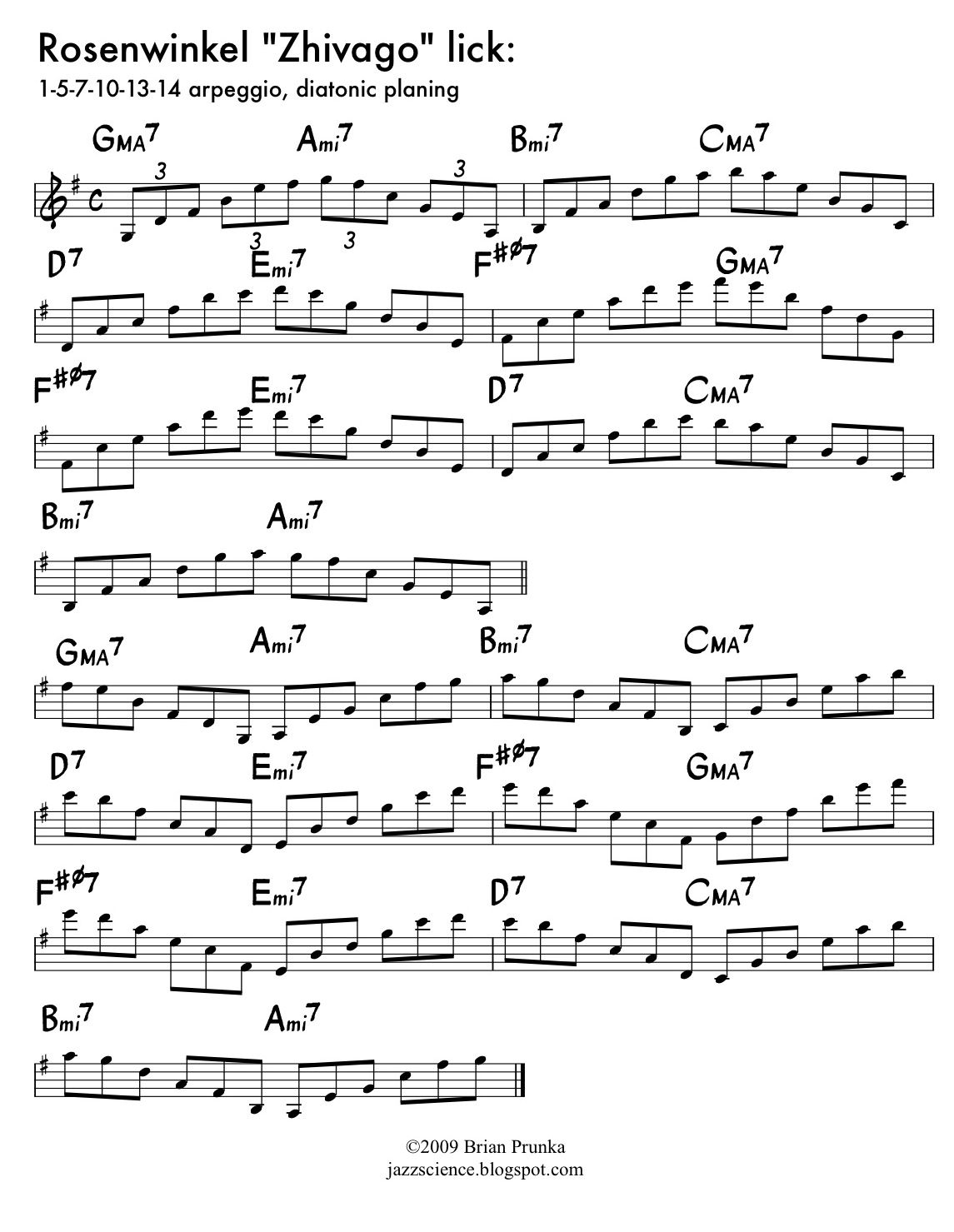
In the previous post, I put up a transcription of a signature line from Kurt Rosenwinkel's solo on "Zhivago" from The Next Step. The line is basically planing a particular arpeggio diatonically, but modifying it to match the underlying chord progression.

To get a better grasp on the device, I took it out of the context of the chord progression and planed the arpeggio diatonically through the major scale. This would also work on any mode of the major scale (dorian, phrygian, lydian, mixolydian, aeolian, locrian), since they all have the same chords.
This could work well in a modal tune like "Milestones", which is a long dorian vamp followed by an aeolian bridge.

The arpeggio is 1-5-7-10-13-14 (10-13-14 being 3-6-7, but up an octave). Rosenwinkel plays them alternating between the ascending and descending version. This works out two ways, depending on whether you start ascending or descending.


Since this is an arpeggio, there are many ways to modify it and come up with different results.  Here are two obvious ones: omitting the root of each arpeggio (which gives you a five-note pattern, creating rhythmically interesting results), and omitting both the root and fifth of each arpeggio (which creates a quartal sound with an interesting ambiguity).


All of these can be played with different rhythmic permutations.
The 5-note pattern is creates interesting cross-rhythms when played as 8th notes or triplets.
The 4-note pattern is more interesting as triplets.
Any triplet pattern can be played with accents on the 8th-note triplet or on the quarter note triplet.  Especially on the original 6-note pattern, I like to mix up the two kinds of triplet accents.

Sunday, November 15, 2009

Kurt Rosenwinkel: Zhivago

Here transcription of "the lick" from Zhivago. I've deconstructed it and will post some of what I came up with in the next post.

Note that he's using his weird tuning so there are some unreachable low notes for a standard guitar.

Friday, November 13, 2009

More Augmented Scale

Here's a continuation of the previous Augmented scale study, using three maj7 chords.

Since the augmented scale can be related to three augmented tonics, it makes sense to me to relate it to the harmonic major (major b6) scale on each of those tonics.


Thursday, November 12, 2009

Triads in the Augmented Scale


Here's an an older one from my workbooks. I've spent a lot of time exploring the possibilities for using various triads in improvisation. They create such strong lines and have a compelling internal logic an musicality.

These examples are pretty bare-bones, but there's a lot to work with.
The Augmented (aka symmetrical augmented) scale is made up of two augmented triads a half-step apart.
It works well over Maj7#5 chords built off the higher of the two triads (it implies a Maj7#5#9 chord). It also works over a dominant 7th chord built off the lower of the two triads (implies 13#5b9).

Wednesday, November 11, 2009

Triads in the Diminished scale

I haven't posted anything to the blog in a while (obviously), but not because I haven't had anything to post! I'm just a bit of a perfectionist and it's been hard to find the time to put stuff into a form that will make sense to other people. I've decided to post stuff a little more haphazardly for now, just so it's more regular.

Here's something from my pile of things I'm working on. The diminished scale has a wide variety of sounds within it, including three different kinds of triads (diminished, minor, and major). This is just a basic presentation of the possible diatonic triads. Interestingly, if you start with a diminished triad and proceed diatonically you get all diminished triads, but if you start with a major or minor triad and proceed diatonically, you get alternating major and minor triads.

triads in the diminished scale

Friday, December 12, 2008

The whole Whole Tone

I like the whole-tone sound, but it can get kind of boring and predictable (true of all the symmetrical scales, but especially the whole tone, since it has the most repetitive pattern . . . whole step, whole step, whole step, whole step, whole step, whole step). I've been exploring ways to spice it up.

One way is to add chromatic passing tones between whole tone degrees. Here are two ways to do it that keep the root, 3rd, and #5 on the beats.


Two augmented triads a step apart have all the notes of the whole-tone scale.
Like in the previous post, whole steps can be filled in chromatically. Here are a couple of very basic versions of Db+ and Eb+ connected by chromatic passing tones (the first line just shows the basic triads).


Here are some other ideas for embellishing the whole tone scale:


The first two use the Db+ Eb+ triad pair. The next two just enclose every scale tone (chromatically below, diatonically above). The next line just encloses one of the two triads. The last line alternates chromatic approach from below and neighbor tone above on different chord tones, always skipping past one chord tone and resolving in the opposite direction.