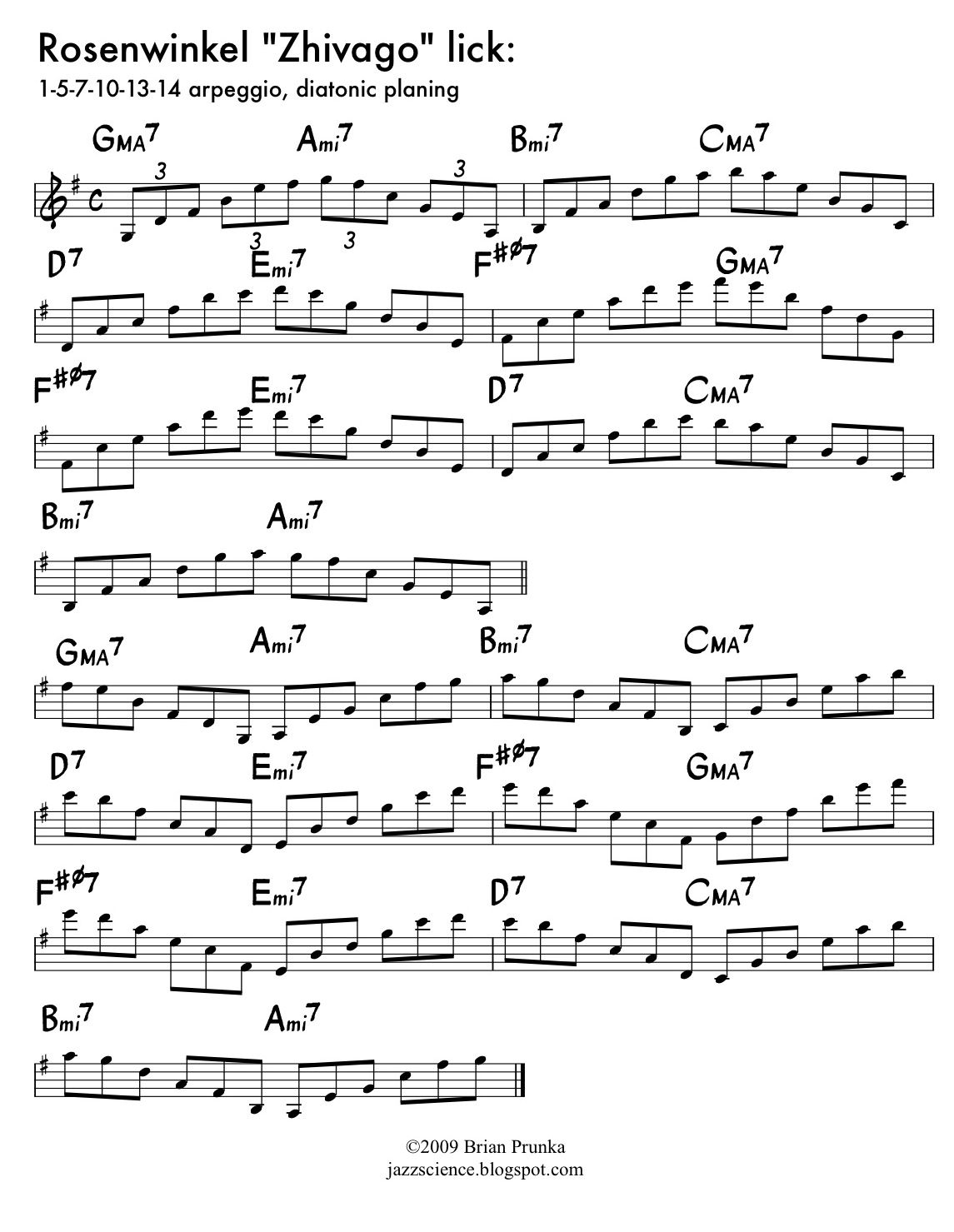
Okay, here's the first post . . . ready?
This is something I've been working on. It was inspired (somewhat secondhand) by George Garzone. Garzone has a whole triadic concept for improvising that I don't know a whole lot about, but some people who have studied with him have mentioned aspects of it to me in passing (his book is kind of a lot of money, but I hope to check it out at some point). An important part of it is connecting triads chromatically by half step and chromatic whole steps. From what I understand, his thing is pretty involved and deals with how you use different inversions, etc. It results in a interesting kind of inside/outside playing. This is sort of some tangential stuff related to a more general approach to improvising with triads, but focusing on the idea of connecting them chromatically. For this exercise I focus on one of the most common pairs of triads: two major triads a whole step apart (Garzone's idea seems to be about freely moving between more or less random triads and resolving them well into the changes, this is just inspired by one aspect of that, and not really related to trying to do that).
Triad pairs are pretty useful in improvising. The can create a lot of interesting sounds. If the triads have no notes in common, then they represent a hexatonic (6-note scale), which gives you a pretty complete harmonic palette to work with.
One of the most useful/common triad pairs is two major triads a whole step apart. This is a popular sound, Kurt Rosenwinkel uses it a lot (which is how I first got turned on to it).
From the standpoint of conventional chord-scale theory, these can represent the IV and V chord from either the major or melodic minor scale. This means they work well on almost any chord from the major scale and on any chord from the melodic minor.
Here I present C and D triads, which would be IV and V in G.
The diatonic chords in G major:
Gmaj7 Ami7 Bmi7 Cmaj7 D7 Emi7 F#mi7b5
Of these, the two triads work most easily over:
IV: Cmaj7 (C=1 3 5, D=9 #11 13) and
V: D7 (C=7 9 11, D= 1 3 5)
Not surprising, since they're IV and V . . .
They work over ii (Ami7) as well, especially if it's going to D7.
They also work well over the viiø (F#mi7b5), but you have to be sensitive to resolving the G to F#.
They can work on the I (Gmaj7), but you have to be pretty careful to make sure you resolve the C to a B (the 3rd) at some point.
They work fine on the vi (Emi7), but tend to obscure the function of the chord (to my ear, anyway). Maybe that's what you want. Or maybe it's not a functional chord (like the bridge on Milestones). In that case, they can sound pretty great.
They work over the iii, but mainly if it's a phrygian chord in a modal context, e.g., B7sus4(b9) or C/B or similar sound. Again, that's to my ear. It can work in a functional context if you're really strong with resolving all the tension that's in the C triad.
In G minor:
Gmi(Ma7), Ami7, Bbmaj5(#5#11), C7(#11), D7(#5), Emi7b5, F#7alt
They work great over all these chords. They do obscure the function of the Gmi chord somewhat, but I wouldn't worry about it too much.
That's the basic usage of these two triads. There are other options, but that's the gist of it.
So, while there are lots of ways to make nice lines with just the two triads, connecting them chromatically increases the options for interesting things to happen. Here are a few lines/shapes that give you the basic idea:

Note that the root always moves to the root of the next chord, the third to the third, the fifth to the fifth.
You could connect the third of the C chord to the root of the D chord as well. That creates some less symmetrical patters.
You can connect them by half-step too, but it can only be between the 5th of the C triad (G) and the third of the D triad (F#). There's not a lot of options. Here are some:

I hope you found this interesting, maybe it'll give you some ideas for some other things.