Update: I linked some parts to my previous posts on Augmented Scale ideas.
Over at the All About Jazz forum, someone asked for suggestions about how to approach Maj7#5 chords. As this is a sound I'm fond of and have spent considerable time exploring, I posted a rather lengthy response.
I'm reprinting part of my response here, since I think it may be of general interest. It's somewhat off the cuff, so the information is probably not optimally organized, so apologies in advance.
--
Maj7#5 can take some different sounds, depending on context. Lydian Augmented (third mode of melodic minor) is one of the scales most commonly recommended as being compatible with a Maj7#5 chord. It's not the only one, though, and others might work much better, depending on the context.
Here are some other possibilities:
Harmonic Minor, 3rd mode (A harm.minor = CMaj7#5)
Harmonic Major (C harm. major = CMaj7#5)
Harmonic Major, 6th mode (E harm. major = Cmaj7#5)
Lydian #5 #2 (C D# E F# G# A B --this is Melodic Minor #4, 3rd mode, i.e., A Melodic Minor #4 for Cmaj7#5)
Symmetrical Augmented scale (C D# E G Ab B)
Harmonic Major (6th mode) is the same as Melodic Minor #4 (3rd mode) AKA Lydian #2 #5. Just two ways of thinking about it.
What notes will work best over the chord will depend greatly on the harmonic context, e.g. the preceding and following chords, etc.
Try finding some tunes that have the sound in it, substituting it in standards, or writing your own, to experiment with different contexts.
The symmetrical augmented scale is a great sound and can be considered as two augmented triads a 1/2 step apart (contrast with the whole tone scale: two augmented triads a whole step apart). Since augmented chords are symmetrical, any note can be considered the root.
Cmaj7#5: C+/B+ or E+/D#+, or Ab+/G+
You can also extend each triad into a maj7 arpeggio:
Cmaj7, Emaj7, Abmaj7
see: More Augmented Scale
or maj7#9:
Cmaj7#9, Emaj7#9, Abmaj7#9
Or you could construct arpeggios by combining the triad pairs into polychords:
B+|C+
=
C E G# B D# G
Eb+|E+
=
E G# C Eb G B
G+|Ab+
=
Ab C E G B D#
You can also reconsider the scale as a major and minor triad a m6 apart:
C/Abm or E/Cm or Ab/Em
There are a million ways to practice these.
Triads in the Augmented Scale
One observation:
Of all the different scale choices over Maj7#5, two particular areas tend to stand out for me:
The choice of whether to incorporate a P4 vs. an A4
The choice of whether or the M6 is included (the alternative is generally the P5)
Since these involve half-steps above the determining color tones of the chord, care must be taken with the melodic resolution tendencies.
The choice of A2 vs. M2 (i.e., #9 vs. 9) is a useful color, but rarely obscures the harmony.
1. Lydian Augmented: has #4 and M6. The #4 implies a Lydian sound and can be a sustained tension, but the dissonance of the M6 obscures the harmony and must be used carefully
2. Harmonic Minor, 3rd mode (Ionian #5): Has P4 and M6, both of which can obscure the harmony and require careful use.
3. Harmonic Major (Ionian b6): Has P4, but no M6.
4. Harmonic Major, 6th mode (Lydian Augmented #2): Has #4 and M6, like Lydian Augmented.
5. Symmetrical Augmented: has neither P4, A4, or M6.
Since #5 omits the problematic tones, it may be an easier scale to start with: it is less likely to lead to obvious clams.
One could create another 6-note scale that leaves out both P4, A4 and M6:
C D E G Ab B. Such a scale might be useful. It could be viewed as a C+/G triad pair or (perhaps less usefully) as a C/Abdim triad pair.
There are a couple of hexatonic subsets that leave out P4 and M6, but include the A4:
C D E F# G# B: this is C+/Bm, a subset of Lydian Augmented
C D# E F# G# B: This is C+/B, a subset of Lydian Augmented #2
The following pentatonics can work as well:
E F# G# B D (these notes form an E9 chord)
Ab B C E F# (these notes form an Ab7+5+9 chord)
C D E F# G# (this is a subset of the whole tone scale, omitting the b7, or the Lydian Augmented, omitting the 6 and 7)
E F# G# B C# (E6 chord or E Maj pentatonic)
The last one includes a b9 on the chord, but this can be a great sound on a modern tune, especially if the chord lasts for a measure or more. It usually works better in the upper register, where it sounds like an extension.
__________________
So there end up being four primary 7-note scale and one 6-note scale possibilities, and a number of pentatonic and hexatonic choices. Here again are the five primary types:
1. Lydian Augmented (AKA Melodic Minor, 3rd mode):
R M2 M3 A4 A5 M6 M7
2. Harmonic Minor, 3rd mode (AKA Major #5):
R M2 M3 P4 A5 M6 M7
3. Harmonic Major:
R M2 M3 P4 P5 m6 M7
4. Harmonic Major, 6th mode (AKA Melodic Minor #4, 3rd mode AKA Lydian Augmented #2):
R A2 M3 A4 A5 M6 M7
5. Symmetrical Augmented:
R A2 M3 P5 m6 M7
Not all choices work equally well in all situations.
No warranty is expressed or implied; indiscriminate scale usage may result in clams, tomatoes, or acts of violence. I do not take responsibility for the careless use of the above information.
happy improvising!
Showing posts with label triads. Show all posts
Showing posts with label triads. Show all posts
Wednesday, August 25, 2010


Friday, February 26, 2010
Ear Training
Ear training is obviously an extremely important pursuit for improvising musicians. I spend a significant portion of my practice time on ear training activities, and try to find ways to incorporate an ear training aspect into all of my practicing.
One of the things that makes harmony so complex is that as you add notes, the complexity increasing in a combinatorial way, not an additive way. For example:
If you hear an E against a C, it's one piece of information: major 3rd.
If you hear an E and a G against a C it's 3 pieces of information: major 3rd between C and E, perfect 5th between C and G, and minor 3rd between E and G.
If you hear an E, G, and B, against a C, it's 6 pieces of information: major 3rd between C and E, perfect 5th between C and G, and minor 3rd between E and G, major 7th between C and B, perfect 5th between E and B, major 3rd between G and B.
If you hear EGBD against C, it's 10 pieces of information: major 3rd between C and E, perfect 5th between C and G, and minor 3rd between E and G, major 7th between C and B, perfect 5th between E and B, major 3rd between G and B, major 9th between C and D, minor 7th between E and D, perfect 5th between G and D, minor 3rd between B and D.
Et Cetera.
So in order to learn all the sounds, we need to give names to specific combinations, like triads, and ultimately triads with added notes (including 7ths).
I've made a set of audio files (mp3 format) based on an exercise suggested by Rufus Reid. Each file presents one of the four triads (Major, Minor, Augmented, or Diminished), and alternates with adding one of the twelve available tones to it. The idea is to learn to hear the sound of all the available notes over each type of chord.
Download file here.
I used triads because once you can identify the sound of the 6ths and 7ths over a triad, then hearing more complex chords is merely a matter of identifying the chord as (Maj, Min, Aug, or Dim) triad+(6, b7, or 7) + additional note(s).
There are more than 12 files for each chord, because I included some notes in more than one octave (specifically, the 2nds/9th, 3rds/10ths, 4ths/11ths, and 7ths). I did this because these notes can have some additional different characteristics when voiced close to the chord, and these differences can distract you from hearing the essential characteristics. For these notes, I suggest spending some time going back and forth between the lower and higher version in order to focus on part of the sound that doesn't depend on what octave you're in.
There's a lot here (76 33-second clips), but it's pretty manageable. There are a lot of ways to work with these files. Here are some suggested playlists:
All Major Triads
All Minor Triads
All Dim. Triads
All Aug. Triads
comparing 3rds/10ths
comparing 4ths/11ths
comparing 2nds/9ths
comparing 7ths close-voiced or spread
All 7ths (or any other interval) over Maj, Min, Aug, Dim triads
Compare min chord with added M3 with major chord with added b3: very interesting!
Compare maj chord with added b6 with augmented chord with added P5
Compare min chord with added #4 with dim chord with added P5
etc.
I hope this is helpful!
PS. There's tons of stuff out there written about ear training, but here are a few of my observations:
-Singing is extremely important.
-Singing over a drone is extremely helpful.
-Deliberately 'hearing' notes in your head before you sing them is very important. You can also use this to work on mentally 'hearing' more than one note at a time.
-Visualizing notes on your instrument as you mentally 'hear' them and/or sing them is very helpful. Visualizing a piano (if your main instrument is not piano) and written music are also helpful.
-Singing the root motion of chord progressions is great exercise. So is singing guide tone lines (3rds and 7ths)
-Intervals can be heard two ways: as harmonic events or as distances. Of the two, it's more important to hear the harmonic event (even when presented melodically). But it's helpful to learn to recognize the sound of a particular distance as well (some people argue that distance-hearing will actually impede your development, but I'm not convinced).
-Testing your ear is not necessarily the same as training it, though it can be helpful.
-One of the main ways we learn to distinguish similar things is through comparison.
One of the things that makes harmony so complex is that as you add notes, the complexity increasing in a combinatorial way, not an additive way. For example:
If you hear an E against a C, it's one piece of information: major 3rd.
If you hear an E and a G against a C it's 3 pieces of information: major 3rd between C and E, perfect 5th between C and G, and minor 3rd between E and G.
If you hear an E, G, and B, against a C, it's 6 pieces of information: major 3rd between C and E, perfect 5th between C and G, and minor 3rd between E and G, major 7th between C and B, perfect 5th between E and B, major 3rd between G and B.
If you hear EGBD against C, it's 10 pieces of information: major 3rd between C and E, perfect 5th between C and G, and minor 3rd between E and G, major 7th between C and B, perfect 5th between E and B, major 3rd between G and B, major 9th between C and D, minor 7th between E and D, perfect 5th between G and D, minor 3rd between B and D.
Et Cetera.
So in order to learn all the sounds, we need to give names to specific combinations, like triads, and ultimately triads with added notes (including 7ths).
I've made a set of audio files (mp3 format) based on an exercise suggested by Rufus Reid. Each file presents one of the four triads (Major, Minor, Augmented, or Diminished), and alternates with adding one of the twelve available tones to it. The idea is to learn to hear the sound of all the available notes over each type of chord.
Download file here.
I used triads because once you can identify the sound of the 6ths and 7ths over a triad, then hearing more complex chords is merely a matter of identifying the chord as (Maj, Min, Aug, or Dim) triad+(6, b7, or 7) + additional note(s).
There are more than 12 files for each chord, because I included some notes in more than one octave (specifically, the 2nds/9th, 3rds/10ths, 4ths/11ths, and 7ths). I did this because these notes can have some additional different characteristics when voiced close to the chord, and these differences can distract you from hearing the essential characteristics. For these notes, I suggest spending some time going back and forth between the lower and higher version in order to focus on part of the sound that doesn't depend on what octave you're in.
There's a lot here (76 33-second clips), but it's pretty manageable. There are a lot of ways to work with these files. Here are some suggested playlists:
All Major Triads
All Minor Triads
All Dim. Triads
All Aug. Triads
comparing 3rds/10ths
comparing 4ths/11ths
comparing 2nds/9ths
comparing 7ths close-voiced or spread
All 7ths (or any other interval) over Maj, Min, Aug, Dim triads
Compare min chord with added M3 with major chord with added b3: very interesting!
Compare maj chord with added b6 with augmented chord with added P5
Compare min chord with added #4 with dim chord with added P5
etc.
I hope this is helpful!
PS. There's tons of stuff out there written about ear training, but here are a few of my observations:
-Singing is extremely important.
-Singing over a drone is extremely helpful.
-Deliberately 'hearing' notes in your head before you sing them is very important. You can also use this to work on mentally 'hearing' more than one note at a time.
-Visualizing notes on your instrument as you mentally 'hear' them and/or sing them is very helpful. Visualizing a piano (if your main instrument is not piano) and written music are also helpful.
-Singing the root motion of chord progressions is great exercise. So is singing guide tone lines (3rds and 7ths)
-Intervals can be heard two ways: as harmonic events or as distances. Of the two, it's more important to hear the harmonic event (even when presented melodically). But it's helpful to learn to recognize the sound of a particular distance as well (some people argue that distance-hearing will actually impede your development, but I'm not convinced).
-Testing your ear is not necessarily the same as training it, though it can be helpful.
-One of the main ways we learn to distinguish similar things is through comparison.
Monday, February 22, 2010
Starting and Ending Phrases, Cont'd.
One specific idea for using wider intervals in the beginnings and endings of phrases is to land on a chord tone and leap two chord tones up or down. This is effective at both the beginnings and endings of phrases or as a standalone melodic motive. All the great improvisers use this idea.
The example below shows what I mean. Over a C major chord, you could play a C and jump down to E (skipping the closest chord tone, G). There are three notes in the triad, so there are only six possibilities (R down to 3rd, 3rd down to 5th, 5th down to root, root up to 5th, 3rd up to root, 5th up to 3rd).
There are also many ways to embellish this idea, with approach tones to the first note or to the second note. Any of the typical embellishments can work on either note (diatonic or chromatic approach, enclosure/encirclement, neighbor tone, etc.). I show a couple of basic examples below.

A good exercise is to pick a particular leap and practice it with a particular approach or ornament through all the changes of a tune. Trying to land directly on "1" each time also helps practice forward momentum by hearing and directing your lines toward a conclusion. Here's example showing one variation, using a common chord progression:

Of course, you would want to create further variations, using the other possible leaps and varying both the approach and resolution.
The example below shows what I mean. Over a C major chord, you could play a C and jump down to E (skipping the closest chord tone, G). There are three notes in the triad, so there are only six possibilities (R down to 3rd, 3rd down to 5th, 5th down to root, root up to 5th, 3rd up to root, 5th up to 3rd).
There are also many ways to embellish this idea, with approach tones to the first note or to the second note. Any of the typical embellishments can work on either note (diatonic or chromatic approach, enclosure/encirclement, neighbor tone, etc.). I show a couple of basic examples below.

A good exercise is to pick a particular leap and practice it with a particular approach or ornament through all the changes of a tune. Trying to land directly on "1" each time also helps practice forward momentum by hearing and directing your lines toward a conclusion. Here's example showing one variation, using a common chord progression:

Of course, you would want to create further variations, using the other possible leaps and varying both the approach and resolution.
Thursday, November 12, 2009
Triads in the Augmented Scale

Here's an an older one from my workbooks. I've spent a lot of time exploring the possibilities for using various triads in improvisation. They create such strong lines and have a compelling internal logic an musicality.
These examples are pretty bare-bones, but there's a lot to work with.
The Augmented (aka symmetrical augmented) scale is made up of two augmented triads a half-step apart.
It works well over Maj7#5 chords built off the higher of the two triads (it implies a Maj7#5#9 chord). It also works over a dominant 7th chord built off the lower of the two triads (implies 13#5b9).
Wednesday, November 11, 2009
Triads in the Diminished scale
I haven't posted anything to the blog in a while (obviously), but not because I haven't had anything to post! I'm just a bit of a perfectionist and it's been hard to find the time to put stuff into a form that will make sense to other people. I've decided to post stuff a little more haphazardly for now, just so it's more regular.
Here's something from my pile of things I'm working on. The diminished scale has a wide variety of sounds within it, including three different kinds of triads (diminished, minor, and major). This is just a basic presentation of the possible diatonic triads. Interestingly, if you start with a diminished triad and proceed diatonically you get all diminished triads, but if you start with a major or minor triad and proceed diatonically, you get alternating major and minor triads.
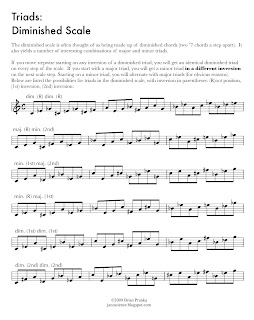
Here's something from my pile of things I'm working on. The diminished scale has a wide variety of sounds within it, including three different kinds of triads (diminished, minor, and major). This is just a basic presentation of the possible diatonic triads. Interestingly, if you start with a diminished triad and proceed diatonically you get all diminished triads, but if you start with a major or minor triad and proceed diatonically, you get alternating major and minor triads.

Friday, December 12, 2008
The whole Whole Tone
I like the whole-tone sound, but it can get kind of boring and predictable (true of all the symmetrical scales, but especially the whole tone, since it has the most repetitive pattern . . . whole step, whole step, whole step, whole step, whole step, whole step). I've been exploring ways to spice it up.
One way is to add chromatic passing tones between whole tone degrees. Here are two ways to do it that keep the root, 3rd, and #5 on the beats.

Two augmented triads a step apart have all the notes of the whole-tone scale.
Like in the previous post, whole steps can be filled in chromatically. Here are a couple of very basic versions of Db+ and Eb+ connected by chromatic passing tones (the first line just shows the basic triads).

Here are some other ideas for embellishing the whole tone scale:

The first two use the Db+ Eb+ triad pair. The next two just enclose every scale tone (chromatically below, diatonically above). The next line just encloses one of the two triads. The last line alternates chromatic approach from below and neighbor tone above on different chord tones, always skipping past one chord tone and resolving in the opposite direction.
One way is to add chromatic passing tones between whole tone degrees. Here are two ways to do it that keep the root, 3rd, and #5 on the beats.

Two augmented triads a step apart have all the notes of the whole-tone scale.
Like in the previous post, whole steps can be filled in chromatically. Here are a couple of very basic versions of Db+ and Eb+ connected by chromatic passing tones (the first line just shows the basic triads).

Here are some other ideas for embellishing the whole tone scale:

The first two use the Db+ Eb+ triad pair. The next two just enclose every scale tone (chromatically below, diatonically above). The next line just encloses one of the two triads. The last line alternates chromatic approach from below and neighbor tone above on different chord tones, always skipping past one chord tone and resolving in the opposite direction.
Two Triads Conencted by Chromatic Passing Tone
Okay, here's the first post . . . ready?
This is something I've been working on. It was inspired (somewhat secondhand) by George Garzone. Garzone has a whole triadic concept for improvising that I don't know a whole lot about, but some people who have studied with him have mentioned aspects of it to me in passing (his book is kind of a lot of money, but I hope to check it out at some point). An important part of it is connecting triads chromatically by half step and chromatic whole steps. From what I understand, his thing is pretty involved and deals with how you use different inversions, etc. It results in a interesting kind of inside/outside playing. This is sort of some tangential stuff related to a more general approach to improvising with triads, but focusing on the idea of connecting them chromatically. For this exercise I focus on one of the most common pairs of triads: two major triads a whole step apart (Garzone's idea seems to be about freely moving between more or less random triads and resolving them well into the changes, this is just inspired by one aspect of that, and not really related to trying to do that).
Triad pairs are pretty useful in improvising. The can create a lot of interesting sounds. If the triads have no notes in common, then they represent a hexatonic (6-note scale), which gives you a pretty complete harmonic palette to work with.
One of the most useful/common triad pairs is two major triads a whole step apart. This is a popular sound, Kurt Rosenwinkel uses it a lot (which is how I first got turned on to it).
From the standpoint of conventional chord-scale theory, these can represent the IV and V chord from either the major or melodic minor scale. This means they work well on almost any chord from the major scale and on any chord from the melodic minor.
Here I present C and D triads, which would be IV and V in G.
The diatonic chords in G major:
Gmaj7 Ami7 Bmi7 Cmaj7 D7 Emi7 F#mi7b5
Of these, the two triads work most easily over:
IV: Cmaj7 (C=1 3 5, D=9 #11 13) and
V: D7 (C=7 9 11, D= 1 3 5)
Not surprising, since they're IV and V . . .
They work over ii (Ami7) as well, especially if it's going to D7.
They also work well over the viiø (F#mi7b5), but you have to be sensitive to resolving the G to F#.
They can work on the I (Gmaj7), but you have to be pretty careful to make sure you resolve the C to a B (the 3rd) at some point.
They work fine on the vi (Emi7), but tend to obscure the function of the chord (to my ear, anyway). Maybe that's what you want. Or maybe it's not a functional chord (like the bridge on Milestones). In that case, they can sound pretty great.
They work over the iii, but mainly if it's a phrygian chord in a modal context, e.g., B7sus4(b9) or C/B or similar sound. Again, that's to my ear. It can work in a functional context if you're really strong with resolving all the tension that's in the C triad.
In G minor:
Gmi(Ma7), Ami7, Bbmaj5(#5#11), C7(#11), D7(#5), Emi7b5, F#7alt
They work great over all these chords. They do obscure the function of the Gmi chord somewhat, but I wouldn't worry about it too much.
That's the basic usage of these two triads. There are other options, but that's the gist of it.
So, while there are lots of ways to make nice lines with just the two triads, connecting them chromatically increases the options for interesting things to happen. Here are a few lines/shapes that give you the basic idea:

Note that the root always moves to the root of the next chord, the third to the third, the fifth to the fifth.
You could connect the third of the C chord to the root of the D chord as well. That creates some less symmetrical patters.
You can connect them by half-step too, but it can only be between the 5th of the C triad (G) and the third of the D triad (F#). There's not a lot of options. Here are some:

I hope you found this interesting, maybe it'll give you some ideas for some other things.
This is something I've been working on. It was inspired (somewhat secondhand) by George Garzone. Garzone has a whole triadic concept for improvising that I don't know a whole lot about, but some people who have studied with him have mentioned aspects of it to me in passing (his book is kind of a lot of money, but I hope to check it out at some point). An important part of it is connecting triads chromatically by half step and chromatic whole steps. From what I understand, his thing is pretty involved and deals with how you use different inversions, etc. It results in a interesting kind of inside/outside playing. This is sort of some tangential stuff related to a more general approach to improvising with triads, but focusing on the idea of connecting them chromatically. For this exercise I focus on one of the most common pairs of triads: two major triads a whole step apart (Garzone's idea seems to be about freely moving between more or less random triads and resolving them well into the changes, this is just inspired by one aspect of that, and not really related to trying to do that).
Triad pairs are pretty useful in improvising. The can create a lot of interesting sounds. If the triads have no notes in common, then they represent a hexatonic (6-note scale), which gives you a pretty complete harmonic palette to work with.
One of the most useful/common triad pairs is two major triads a whole step apart. This is a popular sound, Kurt Rosenwinkel uses it a lot (which is how I first got turned on to it).
From the standpoint of conventional chord-scale theory, these can represent the IV and V chord from either the major or melodic minor scale. This means they work well on almost any chord from the major scale and on any chord from the melodic minor.
Here I present C and D triads, which would be IV and V in G.
The diatonic chords in G major:
Gmaj7 Ami7 Bmi7 Cmaj7 D7 Emi7 F#mi7b5
Of these, the two triads work most easily over:
IV: Cmaj7 (C=1 3 5, D=9 #11 13) and
V: D7 (C=7 9 11, D= 1 3 5)
Not surprising, since they're IV and V . . .
They work over ii (Ami7) as well, especially if it's going to D7.
They also work well over the viiø (F#mi7b5), but you have to be sensitive to resolving the G to F#.
They can work on the I (Gmaj7), but you have to be pretty careful to make sure you resolve the C to a B (the 3rd) at some point.
They work fine on the vi (Emi7), but tend to obscure the function of the chord (to my ear, anyway). Maybe that's what you want. Or maybe it's not a functional chord (like the bridge on Milestones). In that case, they can sound pretty great.
They work over the iii, but mainly if it's a phrygian chord in a modal context, e.g., B7sus4(b9) or C/B or similar sound. Again, that's to my ear. It can work in a functional context if you're really strong with resolving all the tension that's in the C triad.
In G minor:
Gmi(Ma7), Ami7, Bbmaj5(#5#11), C7(#11), D7(#5), Emi7b5, F#7alt
They work great over all these chords. They do obscure the function of the Gmi chord somewhat, but I wouldn't worry about it too much.
That's the basic usage of these two triads. There are other options, but that's the gist of it.
So, while there are lots of ways to make nice lines with just the two triads, connecting them chromatically increases the options for interesting things to happen. Here are a few lines/shapes that give you the basic idea:

Note that the root always moves to the root of the next chord, the third to the third, the fifth to the fifth.
You could connect the third of the C chord to the root of the D chord as well. That creates some less symmetrical patters.
You can connect them by half-step too, but it can only be between the 5th of the C triad (G) and the third of the D triad (F#). There's not a lot of options. Here are some:

I hope you found this interesting, maybe it'll give you some ideas for some other things.
Subscribe to:
Posts (Atom)